
Portrait of Pierre Andrès
Pierre ANDRES was born in Friesenheim (Bas-Rhin) on the 21st of September 1922 and died in Pont-Salomon (Haute-Loire) on the 10th of July 2011.
Moving to the Dordogne with his family at the beginning of the war, he stayed there and obtained an elementary school certificate which opened up a career as a teacher. He was appointed to a small village in the Lot region of France where he was deeply bored, until a drawing teacher revealed his artistic talents and advised him to enter the school of fine arts, which he did by going to Lyon, in the painting section. After two years he enlisted in the Alsace Lorraine Brigade, then in 1945 continued his studies at the school of Fine Arts (Beaux-Arts) in Paris where he met his future wife whom he married in 1947. Returning to his job as a teacher in the Lot he applied the ‘Freinet’ method in a rural environment where only school results counted. In his spare time, he painted, took photographs which he developed himself and made short films with his three children.
It was not until the 1970s, while working as a teaching assistant at the teacher training college in Cahors, that he met a mathematics teacher who suggested that he create objects that could awaken children's sense of space and time. Pierre Andrès then imagined rolling balls on more or less inclined planes, making them cascade, appear, disappear, then reappear and even climb again!
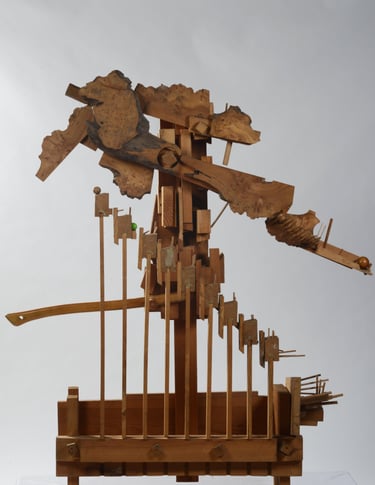
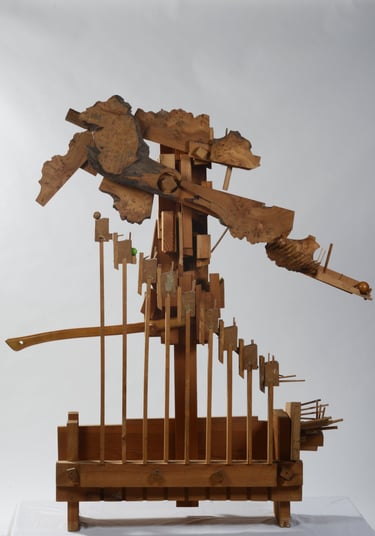
From 1976-77, when he reached retirement age, he began a second career by creating what would be called ‘Les Machines Singulières’ (Singular Machines). Starting from various existing techniques, he transposed them into machines made exclusively of wood: inclined planes, falls from step to step, gears, camshafts, pulleys, levers, pedals, flywheels... He also invented various systems for boxwood balls to climb, the best known of which is the ‘Pompaboule’.
As a former teacher, his concern for pedagogy is constant. He had his first machines tested by friends of the family. The playfulness of the machines is obvious and one discovers see-saws, mazes, lotteries, pinball machines... Some systems are hidden in a pig, a cow, a donkey, a giraffe or an elephant. Children are delighted. Adults are easily taken in by the game. For the machines to work, visitors are required to participate with their skill, their sense of observation or their sense of humour. The artistic sense of Pierre Andrès gives his machines an undeniable aesthetic quality, making them objects of art.
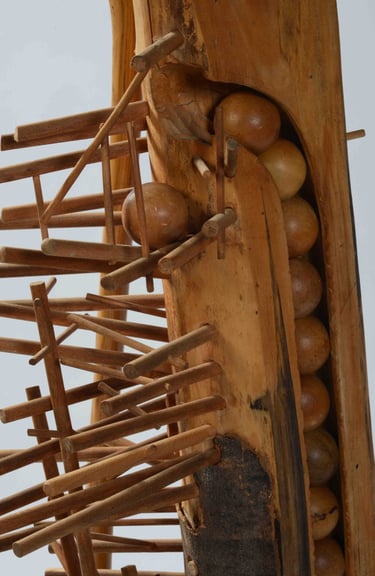
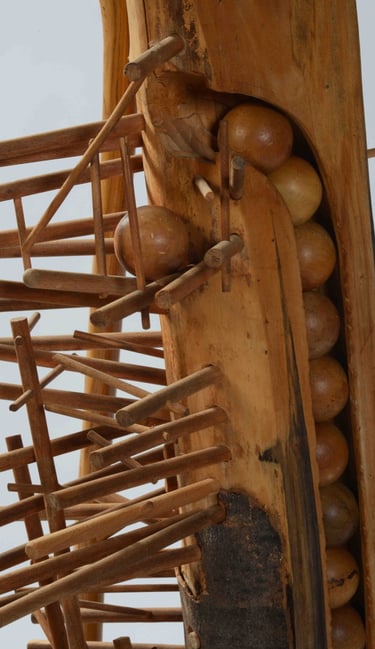
These machines, in addition to their artistic quality, belong to pedagogy, play, technique and sound. The circulation of the balls produces a sound that led Pierre to search for sounds and musical rhythms. The singer Steve Waring uses these machines in some of his shows, such as ‘Fais voir le son’ (Let’s See the Sound). The storyteller Mimi Barthélémy used a famous ‘magic orange tree’ created for her to narrate her Haitian tales.
Pierre Andrès is unclassifiable. As much an artist as a teacher, he has forged links with many creators and teachers. But also, with a wide audience who saw his work at the hundreds of exhibitions he held throughout France and abroad between 1975 and 2005.
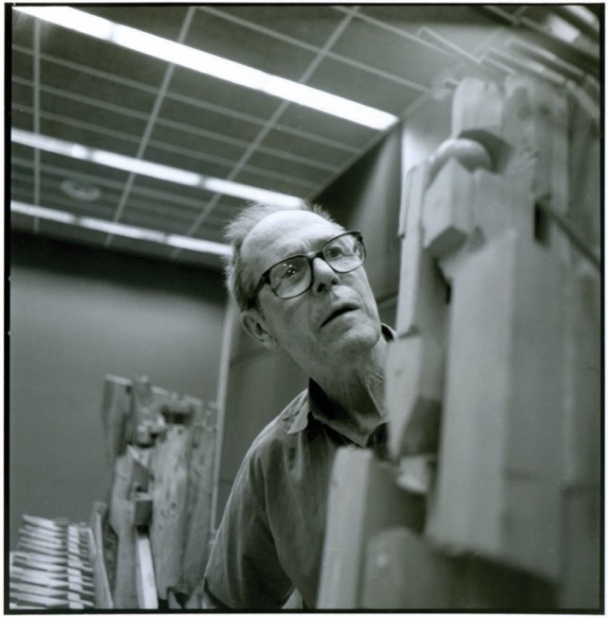
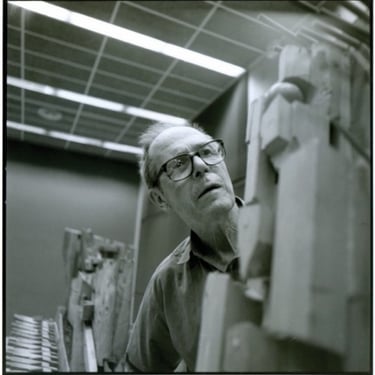
Portrait of Pierre Andrès during his exhibition
‘Les Machines Singulières’ at the Modern Art Museum of the City of Paris 1986.
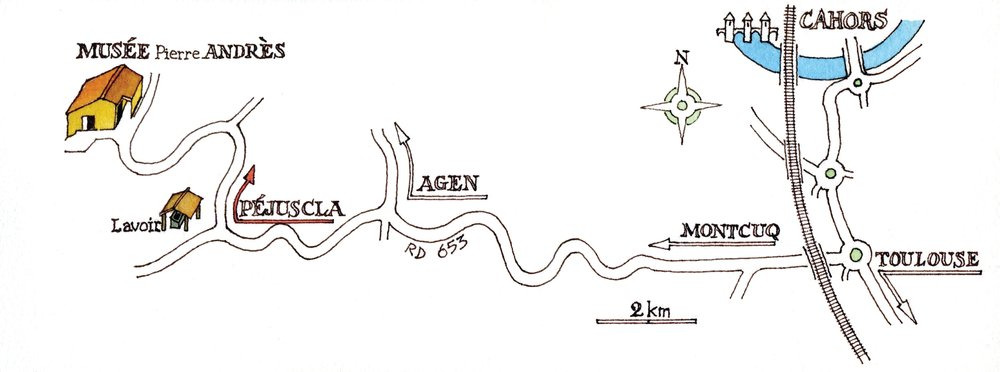
Musée Pierre Andrès
1295 Chemin de Péjuscla
46090 VILLESÈQUE
From Cahors, follow the direction Montcuq
(signposted from the RD 653)